


Investing in Your Image: Why Professional Branding Goes Beyond a Smartphone

Investing in Your Image: Why Professional Branding Goes Beyond a Smartphone
When I’m briefing a new corporate client on their photography shoot, whether they want professional headshots or content that helps their brand stand out, a question I often hear is, “I’ve got a decent smartphone with a good camera, what’s stopping me from doing this myself?”
It’s a fair question, when you consider that smartphone manufacturers are pouring millions into convincing the public that computational photography, essentially, “does the job.” It’s no wonder why a lot of people think their smartphone camera is “as good as professional.”
Here’s the reality; after years of working with everyone from corporate organisations to small businesses, and using high-quality digital cameras (yes, they still exist), I’ve learned how to spot the difference between great lighting, posing & genuine optics compared to software-driven enhancements.
From where I stand, if your business reputation is on the line, settling for smartphone photos simply won’t do your brand justice, at all.
The gear gap
There’s no denying that today’s smartphones are genuinely impressive from a photography standpoint. It’s still remarkable that they can stack multiple exposures, simulate depth of field, and enhance colours with ease, when this seemed virtually impossible years ago. For my family holidays, or when I need something panoramic for a social media banner, a smartphone photo does usually suffice.
However, professional branding photography is a whole different ball game. When I’m shooting corporate portraits or business environments, I’m working with professional mirrorless cameras, lighting equipment and backdrops if needed.
The larger sensors capture profoundly more light information, which translates to a much more pronounced dynamic range. When photographing someone in an office that is bathed in both artificial and natural light from windows, a smartphone will force you to choose which you expose for: the windows or the face. Professional camera gear, however, captures both accurately, maintaining the environmental context while ensuring the subject is the authoritative focus of the shot.
I’ve invested in high-end equipment throughout my photography career, but it doesn’t always have to be brand new to deliver top results. I’m a firm advocate of the circular economy, and with specialised platforms like MPB making pre-owned, professional-grade, used mirrorless cameras a real option for discerning photographers, we can source high-performance equipment in a sustainable and fiscally responsible way. However, even as professional camera equipment has never been more accessible, the gear itself is only half the equation.


The authority factor
Brand imagery encompasses many assets, but none of them should be considered purely decorative. Images like these often represent the first touchpoint: the initial encounter a potential client has with your business. If someone lands on your website or LinkedIn profile, they make an instant judgement about your credibility, and they’re more likely to notice an image before anything else.
From what I’ve seen, DIY smartphone imagery tends to send a subconscious message. Often it suggests that a company hasn’t yet recognised the value of its own professional imagery, or that they are too budget constrained to invest in their growth. In either case, the imagery becomes a barrier to business credibility, when you’re asking clients to invest hundreds or even thousands in your services.
Professional corporate photography creates a sense of what I like to call “visual authority.” The combination of proper lighting, precise focus control, authentic colour reproduction, and the avoidance of distractions, all while following the professional photography rulebook, communicates a sense of confidence before your audience even absorbs what you’ve said.
It’s the equivalent of turning up to a business meeting in a tailored suit versus tracksuit bottoms.
Beyond the shutter
If a business considers the DIY photography route, they’re often only thinking about the moment that the shutter clicks. What they don’t see is the workflow that surrounds that moment.
Before I even arrive at a corporate photography shoot, I’ve consulted on:
- Location(s)
- Planned lighting setups
- Shot types
- Props and styling
- Timings and contingency plans
I’ve invariably coordinated with stakeholders and planned an itinerary using project management tools like asana, ensuring I have communicated and prepared for everything I need before, during, and afterwards. On photoshoot day, I’m always checking lighting, directing subjects, and ensuring consistency across possibly several hundred images.
The post-production phase is vital. Retouching and editing isn’t about making people look artificial, but rather about presenting them at their most authentic while maintaining natural skin tones, textures, background colours, and more. Adobe Lightroom’s advanced colour grading tools are, for me, excellent at ensuring brand colours are accurately conveyed across all deliverables, which just cannot be replicated with smartphone camera and editor applications. Their one-size-fits-all filters and gradients may be OK for basic graphics, but rarely anything of true substance as far as professional branding is concerned.
The ROI of professional brand photography
It’s important to discuss this evergreen investment versus expense debate.
If you’re spending £500 on a mobile phone and attempting a corporate shoot yourself, you may be saving yourself the flat fee of a professional photographer. But at what cost?
Consider this: if your website converts visitors at 2%, and professional branding photos increase that to 3% (a realistic estimate based on my clients’ reported improvements), that’s already a 50% increase in new business.
For most small businesses, a single additional client more than covers the investment in professional, high-quality imagery.
I’ve watched businesses transform their market positioning with strategic brand photography. One professional consultancy firm I worked with reported that prospects mentioned their “premium positioning” during their initial discovery calls, which was largely attributed to the high-quality imagery across their digital estate (website, social media, printed marketing materials, etc.)
Even if you’ve personally invested in a professional camera, lenses and lighting (equipment that can now total upwards of five figures) there’s often an expertise gap that can’t be quantified easily. Professional photographers don’t just have the equipment, they know how to:
- Balance ambient light with flash
- Position subjects to minimise unflattering shadows
- Apply the ‘rule of thirds’ principle for dynamic composition
- Make efficient use of busy professional’s time while reassuring the ‘camera shy’
When I’m shooting in a busy corporate office, I’m simultaneously managing camera settings, directing subjects, ensuring consistent lighting across different setups, watching for distracting background elements, and capturing authentic, candid moments where it matters. This level of multitasking comes from years of experience, not just owning the equipment that captures all the important subtleties and nuances.
Make the smart decision
Of course, nobody’s saying that you can’t take good photographs with a smartphone. You undoubtedly can. But the question is whether those images are going to truly communicate the level of professionalism, attention to detail, and quality that your business offers and deserves to be recognised for.
Your brand imagery doesn’t exclusively work during traditional business hours – it works around the clock, representing your company to an endless number of potential clients, partners and employees. Your brand imagery appears on your website, social media pages, profiles, proposals, presentations, marketing materials, and other collateral. Every single impression matters.
Just like you wouldn’t ask your business accountant to rewire your office, even if they’ve got a decent toolbox at home, you wouldn’t ask an inexperienced photographer to encapsulate your brand in imagery to propel your business forwards. While it might be tempting (and cheaper) to engage your friend’s son who’s at college studying photography and looking to diversify his portfolio, the results you’re looking for as an ambitious, growth-minded business looking to scale will only disappoint.
When you’re ready to invest in imagery that truly represents your business value, and create that competitive edge that you’ve been looking for, work with a photographer who understands the technical requirements and strategic effect of high-quality brand photography. Your business and bottom line will both thank you for it.


NHS portrait exhibition
NHS portraits in Warwickshire
I think NHS staff deserve a lot of recognition and thanks after the last few years. This project let me do that in a small way. These photos form an exhibition now at on display Warwick Hospital. It celebrates sustainability initiatives made by staff across South Warwickshire NHS Foundation Trust, as part of a Green Team competition – and shows that we can all make small differences to help climate change and reduce waste.
I created photos of community teams in and around Warwick, reflecting their working environment and the changes they’ve made to reduce the environmental impact of their work. Others were taken at Warwick, Leamington and Stratford hospitals, again in the daily working environment of each team. I’ve nothing but huge admiration for the often very challenging work they do.
Huge thanks to all the NHS colleagues involved for their help & enthusiasm, Caroline Lloyd for running & organising the project brilliantly, and to project partner Clare Underwood at Peeli Print for producing the fabulous acrylic displays for the exhibition.


How to organise staff headshots
How do I organise staff headshots at my company ?
Staff headshots help create a cohesive and professional image for your company. They also showcase your team’s personality. Organising them can be a little more involved than you might think, so hopefully this article will help.
Style choice
There’s two basic styles to choose from. The traditional, classic and clean look is against a plain background. This gives a professional and consistent appearance.
Environmental portraits, on the other hand, show people within their work environment, offering a more relatable and personalized touch. This approach captures authenticity and relatability. The photographer will find suitable interesting spots around your office, or perhaps outdoors. The photography will probably take a little longer to do, increasing the budget a little.
You might need a wider variety of images for senior staff for different uses.
The style you choose should match with your company’s culture, values, and what you want to convey. It’s all about making the right impression, the expectations of your target audience and how they perceive your brand.


Getting the date(s)
Plan well in advance so everyone has ample time to prepare. Timing is important to make it as convenient as possible and to make sure everyone is present at work. It might help to have the photo shoot on the day of a meeting, a company-wide event, or a team-building session.
With working from home more common, this part can be tricky! Infact, it’s often a good idea to schedule another, shorter session for the people who couldn’t make the first day.
Telling everyone about it
Let everyone know a few weeks ahead of time, and remind them again the day before. People will want to get their hair cut and think about what clothes they’ll wear. They may need guidance on clothes, whether it be the company branded polo shirt (a clean one!) or jacket and tie. Some might bring along a hairbrush and their makeup to make sure they are looking good.
Location
A separate room is ideal. A private space means that there’s minimum disruption to the rest of the office and people will feel less self-conscious. So book a meeting room. It needs to be larger than you’d think to fit the photographer’s lights, background etc. At least 4-5m long
For environmental portraits, a private space is still needed, but different locations might be used by the photographer

Budget & requirements
Costs can vary depending on the number of staff and the style you’re going for. Different photographers will charge in different ways. I charge for my time and can be flexible. It typically takes 5-10 mins per person. Some people know exactly the look they want and it can be quick to photograph them. The majority are less confident and it takes a little longer to make them feel relaxed. I sometimes show people their photos on the back of the camera to reassure them.
On the day
Create a schedule after talking to the photographer about how long is needed for each person. Someone from the office will probably be needed to make sure people are on time and to help things run smoothly.
A good photographer will put people at ease, especially those who are nervous about the whole thing. They will also bring a mirror and a lint brush to remove pet hairs from clothing!
When it’s all done, talk with your photographer about the process for selecting the photos. Will people get to choose their favorites? Make sure everyone understands the next steps and when they can expect their photos.
Keep it up-to-date
Don’t forget that headshots need a refresh every once in a while to reflect changes in your team or company’s branding. It’s a good idea to have a budget for occasional smaller sessions to cover the new arrivals.
If you want to chat about staff headshots, please get in touch.
I normally create professional headshots in Warwickshire, Birmingham and surrounding areas, although I do travel further afield. I also offer event photography and personal brand photography.

Headshot and team Photography
Headshot and team photography in Warwickshire
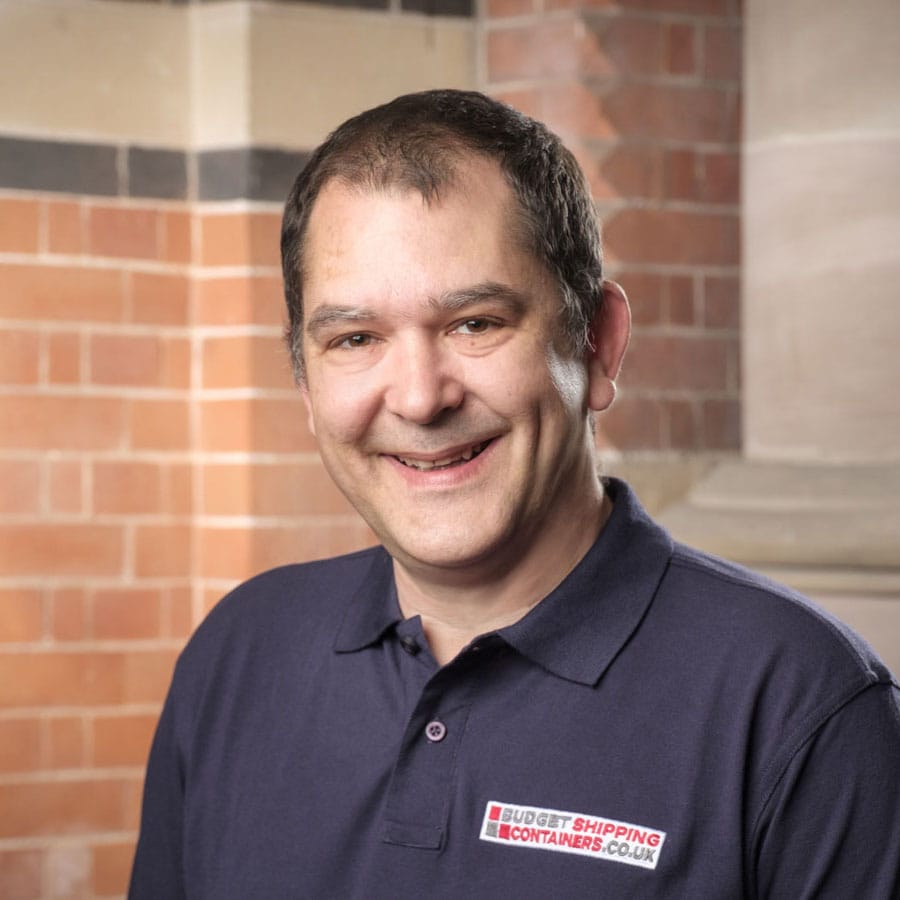
Chris Osborne at Budget Shipping Containers in Wythall, Warwickshire needed photography of his staff – individual headshots and team photos. They were primarily for the website and social media.
We talked beforehand about various options. The office is very unusual and full of character. It’s in a converted church. We decided to use the character of the church to add something different to the photos (I also suggested getting everyone on top of a shipping container for a team photo, but unfortunately there weren’t any full size containers onsite! There was a small container that we used). We chose the background for the headshots to be an inside wall of the church.
We also used a side entrance, in front of an arched wooden door, as the location for one of the team photos. Chris and the team were great fun, getting fully into the spirit of the shoot, and we created images with a few themes in mind for social media campaigns. One was a rainbow theme, with everyone in different colour T-shirts, even in the correct order for a rainbow (for LBGT awareness).
A second location was in front of a small shipping container (that comes as a flat-pack) to match the business service.
Chris & I agreed on the value of good headshots. His business has clients from around the country, and the staff spend a lot of time on the phone talking to potential clients. Many will have found Budget Shipping Containers via their website. The headshots and team photos on the website help make an immediate personal connection with the client, building the know, like & trust. As Chris said:
“Thanks again Laurence, it went very well and everyone is really happy with their photos! A number of customers have commented how adding staff photos to the website and our electronic stationary has helped make our team a lot more relatable and approachable. I was personally worried if this would be a cost-effective exercise but now we’ve tried it it’s proven to be well worth getting professional photos done!’



Product Photography - fishing tackle
Product Photography of Fishing Gear & Tackle
Arrow Angling is a startup business in Redditch, Worcestershire. They sell very high quality yet affordable fly fishing and angling rods, reels, nets and other tackle. Marc is working extremely hard getting the business up and running. To increase online sales, he needed outstanding photos to show off the products – a few photos of each product, plus detailed close ups to show the quality of the finish. As Marc said, a picture is worth a thousand words.
I created the photos in my studio in Studley. White backgrounds were the simplest way to present the products for ecommerce, displaying all the components of the tackle and retaining realistic shadows.
When he saw the photos Marc said “They’re fantastic ! I can’t praise Laurence enough for the excellent service and quality product photos he provided for our new startup business. Professional and communicative throughout. Looking forward to doing more business with him in the future.”
If you like fishing, take a look at Arrow Angling where you’ll find outstanding tackle (& more of the photos put to use !).
You can also see more examples of my product photography for Warwickshire


The importance of social media for your business


The importance of social media for your business – by Amy Marshment
Whether you’re a creative, corporate, or sales business; the power that social media brings to your brand is vast. With social media comes an endless pool of news, trends, connections, stories, and knowledge. This might seem overwhelming, but when harnessed in the correct way, it is an opportunity to form important relationships, grow your brand’s awareness, and network like never before on an international scale.
Social media is also relatively inexpensive, it’s free to sign up to most platforms that can make a real difference to your brand. Take Instagram for example, you can find anyone on there from writers, graphic designers, PR agencies, photographers, scaffolders, and beyond! It’s not just for the creatives with an eye for visuals. Although Instagram is about uploading images in a square grid, it’s much more than that. It’s an opportunity for you to show off your businesses’ strengths up close, whether that’s your branding, your workforce, or daily duties. Plus, if you sell a physical or online product, there’s the opportunity to use shoppable buttons on your images! There might be a wide range of people in the Instagram community, but with the right hashtags, using significant keywords, and certain tips and tricks- it’s a winning platform to use.
Twitter is also a useful space for networking. You can join local twitter threads (conversations) to introduce yourself, discover what’s happening, and even sell your services. There are many accounts that will re-tweet (re-share) your content, boosting your content up to an extortionate amount of users to see!
It can be a minefield when it comes to choosing which platforms your business should join, as well as the ones that don’t necessarily meet your audiences’ requirements. Once you know your unique selling point, your niche or industry, and who you’re marketing to… this can make it a whole lot easier when choosing which platforms to use. It’s also more than ok to trial a certain platform for a month to see what kind of traction you are getting and whether it’s right for you. Experimenting with different social accounts is useful when looking at your insights. If you create a creator or business profile on Instagram, you can have a look at where in the world your content is being seen, your key demographics, and what content is performing best.
There’s so much to learn, benefit from, and test. Social media can be timely, but the reward is certainly worth the energy. Social media can help with your website hits, generating awareness of your brand, targeting potential customers, and meeting people who share the same values as you. A top recommendation that I would propose is to only use 2-3 social platforms if you are a small business, unless you have a great scheduler or dedicated person to organising your social strategy. It’s important to be active, responsive, and consistent when it comes to social media. This allows for a higher retention and engagement rate. People want to constantly see newness and with so much social noise, they need a reason to keep coming back to your pages.
If you’d like more detail on how social media can be an effective strategy for your brand, please don’t hesitate to contact Amy at amyemarshment2@hotmail.co.uk or visit her website amymarshment.com
Amy’s social links:
Website: amymarshment.com
Instagram: https://www.instagram.com/amymarshmentx/
Twitter: https://twitter.com/amymarshmentx
Pinterest: https://www.pinterest.co.uk/amymarshmentx/
